

Smog season is approaching across Punjab's plains. As October turns to November, the grey haze returns to cities and highways, bringing poor visibility, irritated eyes and real risks to our health.
In this brief, we explain when smog usually builds and peaks, what causes it, how to tell it apart from fog, how to read the Air Quality Index (AQI), and the simple steps you can take to protect yourself and your family.
When does smog season start?
Smog usually starts building in late October, is worst from November to January, and eases in February when rain and stronger winds return.
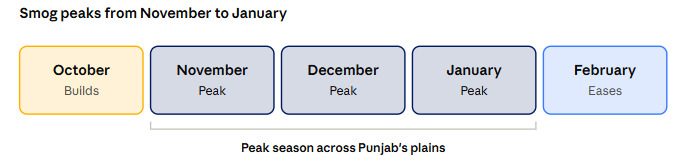
November to January are the typical peak smog months across Punjab's plains. During these weeks, haze can settle over cities for days at a time.
What causes smog?
Smog forms when pollution from the ground meets winter weather that keeps it from escaping. Four factors work together:
- Emissions: traffic, industry and brick kilns release fine particles into the air every day.
- Crop burning: stubble fires across the region add large amounts of smoke in autumn.
- Still air: weak winter winds fail to carry pollution away, so it builds up over towns and cities.
- Temperature inversion: cold air near the ground gets trapped beneath a layer of warmer air above, holding the pollution close to where we breathe.
Pollution is present all year, but in winter the weather turns it into smog.
Fog and smog are not the same
Fog and smog can look alike from a window, but they are very different.
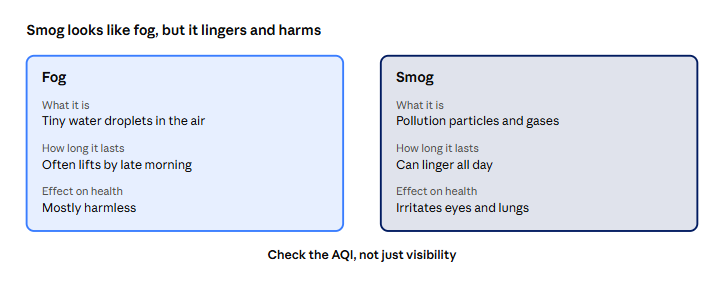
Because smog can look like fog, don't judge the air by visibility alone. Check the AQI.
Know your AQI
The Air Quality Index (AQI) measures how polluted the air is: the higher the number, the greater the health risk. When it climbs above 150, everyone should cut back on time outdoors.
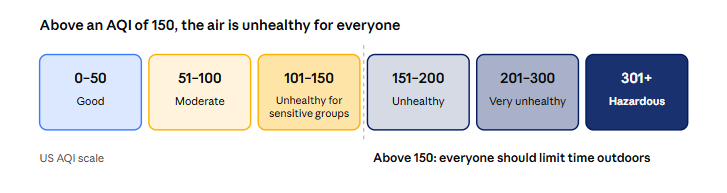
These ranges follow the US AQI scale. Readings vary between monitors, so use a trusted local source.
How to protect yourself
A few simple habits can greatly reduce your exposure during smog season:
- Mind the mornings and evenings: pollution often peaks at these times, so limit outdoor exercise then.
- Wear a mask outdoors: a well-fitted N95-type mask offers real protection.
- Keep the air indoors clean: close windows on heavy smog days.
- Look after higher-risk groups: children, the elderly and people with asthma should take extra care.
- Drive carefully: smog cuts visibility, so slow down and keep your headlights on.
